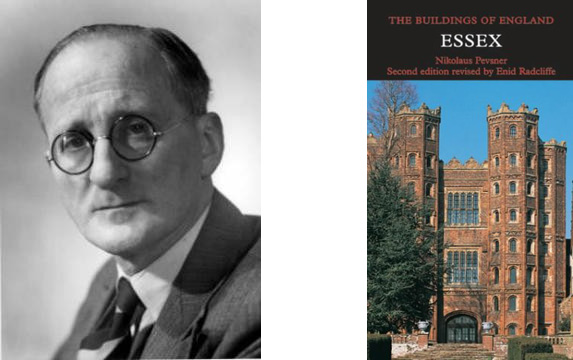
I came across the phrase a ‘Geography of Art’ in The Englishness of English Art, a book of a series of BBC Reith Lectures given by Nicholas Pevsner in 1955.
Pevsner went on to became a British household name with his definitive Guides to British Architecture, covering every county of England and Wales. His Guides grew from years of site visits and careful research, and his early lectures give an insight into their inspiration.
Pevsner’s interest in Englishness was not inspired by blood and soil thinking. As a Jew escaped from Hitler’s Germany, his talks disavowed narrow political nationalism. His approach, rather, was to look for, record and value the specific, local and often contradictory things within British art and architecture.
Some of his lecture points were not convincing. For example, verticality in medieval church sculpture is not, as he suggests, exclusively English but European; and Hogarth’s close observation of modern life is hardly unique to England either. But his ideas about how geography shapes art, expressed most clearly in a talk about Constable and the weather, always struck me as sane, resonant and worth developing.
Pevsner’s thinking was multi-layered. For example, Pevsner observed that the visual effects of changeable weather on the English countryside: cloud patterns, the deep greens of wet vegetation, wet red brick and reflections in water all became, elements of Constable’s art. At the same time details of the economy and environment also made it into the paintings. If we add to this list the wild and domestic fauna and flora of Suffolk, the best characterisation for this interconnected range of interest and understanding does seem to be ‘geography’.
From an art critical point of view, it’s not so much that landscape paintings can ‘pick out’ points of geography – there’s a mountain, here’s a town – though of course it can. It is, rather, that to describe how meaning in landscape painting gets made, geography must be involved. Exactly how and to what extent this happens will vary from artist to artist, work to work; but in general I think we can say that geography gets wrapped up in the medium.
After all, what is the space and layout of a landscape painting but a relationship with the environment? Paintings can propose or forbid routes through the land. They can consider land use. Colour can link human or animal activity to time of day; form and texture can describe geology, and patterns of flora given a context, and so on. All these things are geographical, yet each can be uniquely seen, thought and felt in paint.
Notice the connections : SIGHT – KNOWLEDGE – AFFECT.
I think that energising this chain is a central function of painting. And after years of painting observed landscape in different parts of Britain myself, I see the geography of art as something that helps me to understand both what I do, and also the work of others.
 the geography of art